Acknowledged Legislator by Edward J. Carvalho
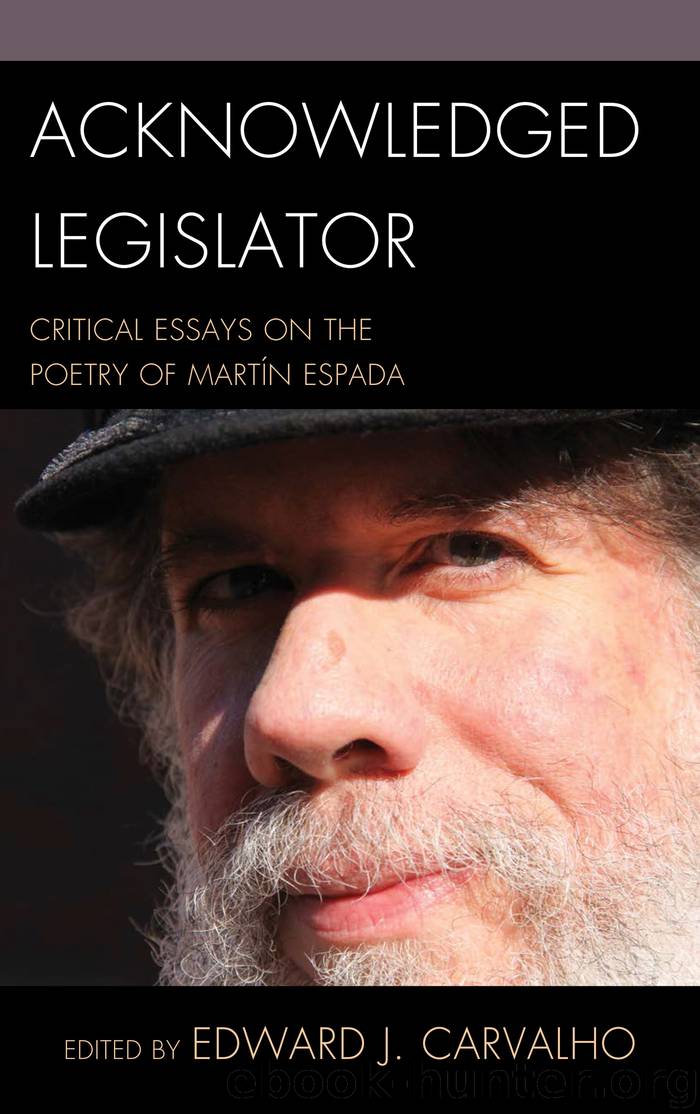
Author:Edward J. Carvalho
Language: eng
Format: epub
Tags: undefined
Publisher: Fairleigh Dickinson
Published: 2012-03-17T04:00:00+00:00
Espada’s poetry succeeds in embedding and reflecting the “transcendent possibilit[ies]” referred to above in the context of a work characterized by successive reappropriations of personal and collective history.
The Poetry of Liberation
The “poetry of liberation” is then an aesthetic that coincides with much of what Roberto Márquez sought to capture in his 1974 anthology Latin American Revolutionary Poetry/Poesía Revolucionaria Latinoamericana, a seminal work in Espada’s awakening to the radical transformative potential of poetry, and, in particular, the way the poets included there combine the “lyrical with the prophetic, and [. . .] the apocalyptic” (R. Márquez 26). Its characteristics are also exemplified by the late Sandy Taylor and Judy Doyle’s contributions through Curbstone Press and their unflagging support for Espada and the other poets they have made it possible to read (many of whom were included in the Poetry like Bread anthology). My approach here toward outlining key elements of such a poetry build on Márquez’s fundamental contributions, but with the contemporary equivalent of a more globalized perspective, such as that explored by Alan Bold in his classic anthology The Penguin Book of Socialist Verse (1970). So, too, my approach includes the kind of testimony highlighted by Carolyn Forché in her anthology Against Forgetting: Twentieth Century Poetry of Witness (1993), particularly her definition of the “social,” “a place of resistance and struggle, where books are published, poems read, and protest disseminated [. . .] the sphere in which claims against the political order are made in the name of justice,” and her understanding that it is “resistance to terror [. . .] [that] makes the world habitable” (31, 46). Forché was a key member of the distinguished panel (which also included Daniel Halpern and Charles Simic) that honored Espada’s completely bilingual book Rebellion is the Circle of a Lover’s Hands/Rebelión es el giro de manos del amante (1990) with the PEN/Revson Award for Poetry, accompanied by the following statement (excerpted):
“Whoever in the future wishes to find out the truth about our age will have to read poets like Martín Espada. [. . .] These are poems about hard work and poverty and discrimination. He is the poet of that knowledge, the full weight of that knowledge. The greatness of Espada’s art, like all great art, is that it gives dignity to the insulted and the injured of the earth.” (qtd. in M. Espada, Rebellion/ Rebelión 121)
Download
This site does not store any files on its server. We only index and link to content provided by other sites. Please contact the content providers to delete copyright contents if any and email us, we'll remove relevant links or contents immediately.
Waking Up in Heaven: A True Story of Brokenness, Heaven, and Life Again by McVea Crystal & Tresniowski Alex(37944)
Still Foolin’ ’Em by Billy Crystal(36491)
Cecilia; Or, Memoirs of an Heiress — Volume 1 by Fanny Burney(32746)
Cecilia; Or, Memoirs of an Heiress — Volume 2 by Fanny Burney(32108)
Cecilia; Or, Memoirs of an Heiress — Volume 3 by Fanny Burney(32089)
Fanny Burney by Claire Harman(26748)
Empire of the Sikhs by Patwant Singh(23218)
We're Going to Need More Wine by Gabrielle Union(19223)
Hans Sturm: A Soldier's Odyssey on the Eastern Front by Gordon Williamson(18735)
Plagued by Fire by Paul Hendrickson(17556)
Out of India by Michael Foss(17038)
All the Missing Girls by Megan Miranda(16813)
Cat's cradle by Kurt Vonnegut(15583)
For the Love of Europe by Rick Steves(14997)
Pimp by Iceberg Slim(14818)
Molly's Game by Molly Bloom(14281)
Bombshells: Glamour Girls of a Lifetime by Sullivan Steve(14240)
Leonardo da Vinci by Walter Isaacson(13543)
4 3 2 1: A Novel by Paul Auster(12638)
